What Your General Home Inspector Probably Didn't Check
Purchasing a home in Charlotte, NC is one of the largest financial decisions most families ever make, and buyers rightly want to know exactly what they're getting. The standard home inspection covers the roof, electrical system, HVAC, plumbing, and structure — but when it comes to the chimney, most general inspectors have significant limitations.
A licensed home inspector will typically note obvious external issues: a visibly missing cap, a clearly crumbling crown, or open cracks in the exterior masonry. What they cannot do is evaluate the condition of the flue liner, the smoke chamber, the damper assembly, or the firebox mortar with any meaningful depth — and those are the components most likely to harbor dangerous and expensive defects.
Why the Flue Liner Is the Critical Unknown
The flue liner is the innermost layer of your chimney system. It contains combustion gases, directs them safely out of the home, and protects the surrounding masonry from the extreme heat of a working fire. Cracked, offset, or deteriorated liner sections allow carbon monoxide and superheated gases to escape into wall cavities and living spaces — a serious life-safety issue that shows no external symptoms until conditions are already hazardous.
Clay tile liners — the most common type found in Charlotte-area homes — are particularly vulnerable to cracking from thermal shock (a sudden, very hot fire after a period of disuse) and from the freeze-thaw cycles that occur during Charlotte's winters. These cracks are completely invisible from inside the firebox and impossible to detect without a camera.
What a Level II Chimney Inspection Covers
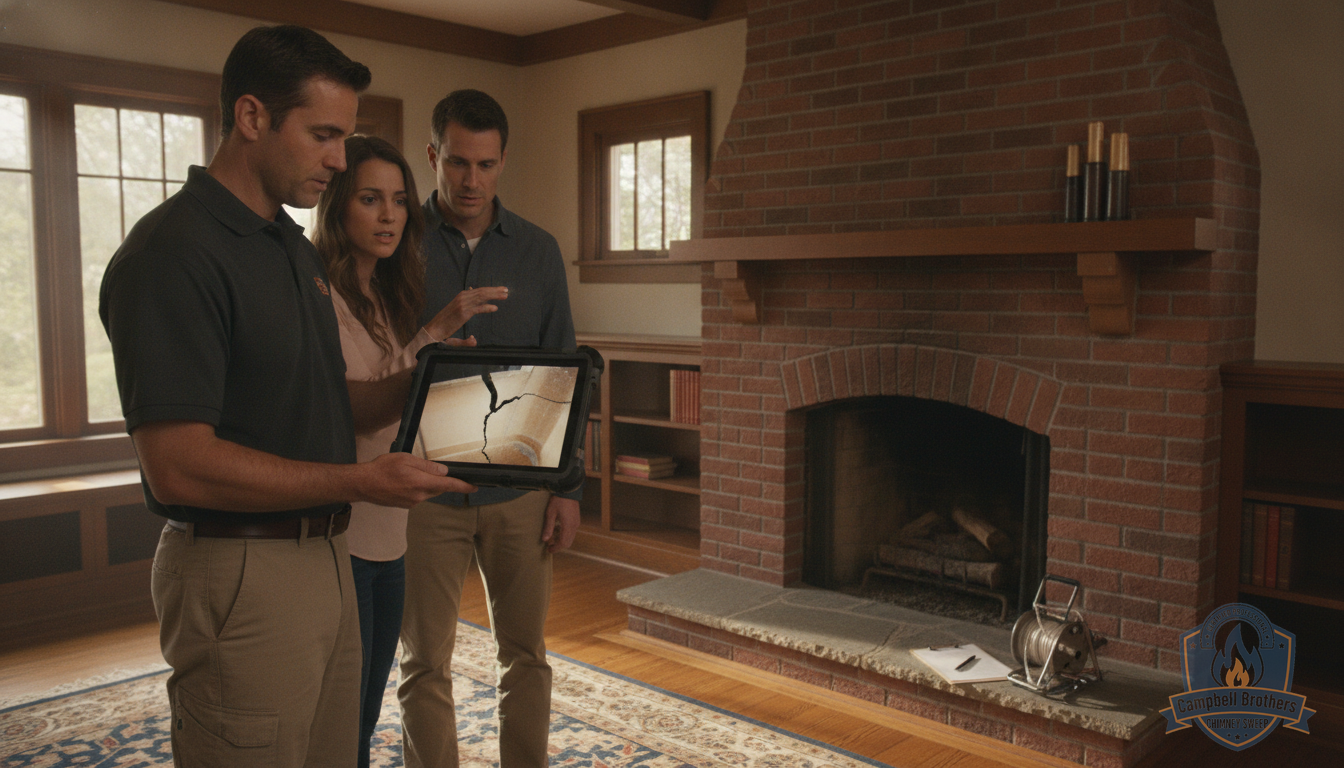
NFPA 211 defines a Level II chimney inspection as the required standard during any real estate transaction. Unlike a Level I inspection, which covers only accessible components with no special tools, a Level II inspection includes video camera scanning of the full flue interior from firebox to chimney top.
Campbell Brothers Chimney Sweep's Level II chimney inspections include a systematic evaluation of:
- Flue liner: Camera scan to identify cracks, offsets, deteriorated mortar joints between tile sections, and any buildup that restricts the flue opening
- Firebox and smoke chamber: Visual inspection of firebrick condition, refractory mortar joint integrity, and smoke chamber parging
- Damper assembly: Operation, sealing, and corrosion assessment
- Chimney crown: Crack identification, slope, and drip edge condition
- Chimney cap: Presence, fit, mesh condition, and corrosion
- Flashing: Seal integrity at the roof-to-chimney junction, step flashing condition, and counter flashing embedment
- Exterior masonry: Spalling brick, mortar joint erosion, and structural concerns
Every inspection is fully photo-documented, and we provide a written report explaining each finding in plain language — not chimney jargon. You'll know exactly what's there, what it means, and what it would cost to fix before you proceed with your purchase.
Common Defects We Find in Charlotte-Area Home Purchase Inspections
In our experience serving buyers throughout Mecklenburg County and the surrounding communities, the most frequently discovered issues in pre-purchase chimney inspections include:
- Cracked or separated clay tile flue liner sections requiring relining
- Deteriorated smoke chamber parging with open gaps to the surrounding masonry
- Missing or builder-grade chimney caps that have failed and allowed years of animal and water intrusion
- Improperly installed or completely failed flashing that has been channeling water into the attic undetected
- Cracked chimney crowns with no drip edge that have allowed moisture to saturate the brick below
- Firebox mortar joints eroded beyond safe use, requiring firebox tuckpointing with proper refractory mortar
In many cases, these issues are entirely repairable at a reasonable cost — but knowing they exist before closing gives you leverage in negotiation, the ability to require seller repairs, or simply the informed choice to factor repair costs into your offer.
Don't Rely on the Seller's Disclosure
North Carolina's residential property disclosure form asks sellers whether they are aware of any defects in the fireplace or chimney. However, many sellers have never had their chimney professionally inspected and genuinely don't know the condition of their flue liner or crown. A disclosure of "No known defects" does not mean the chimney is defect-free — it simply means the seller isn't aware of any.
The only way to know the actual condition of a chimney system is to have it evaluated by a trained specialist with camera equipment and direct access to every component.
Scheduling a Pre-Purchase Inspection in Charlotte
Campbell Brothers Chimney Sweep serves home buyers throughout Charlotte and its surrounding suburbs, including SouthPark, University City, Matthews, Pineville, and Steele Creek. We understand that real estate timelines are tight, and we work to accommodate inspection scheduling during your due diligence period.
If our inspection identifies issues, we can provide written repair estimates for each deficiency — documentation you can use directly in negotiations with the seller or their agent. And if you proceed with the purchase, we're the team ready to handle any needed repairs, from crown repair to flashing replacement to a new chimney cap, as well as an initial chimney sweep and cleaning to start your homeownership off safely.
Call Campbell Brothers Chimney Sweep at (980) 780-2225 or email [email protected] to schedule your pre-purchase chimney inspection. We're available seven days a week, 8 AM to 6 PM, at 6132 Brookshire Blvd, Charlotte, NC 28216.
Need Service?
Call +19807802225 or fill out our online form for a free, no-obligation quote.
Request Free Quote