
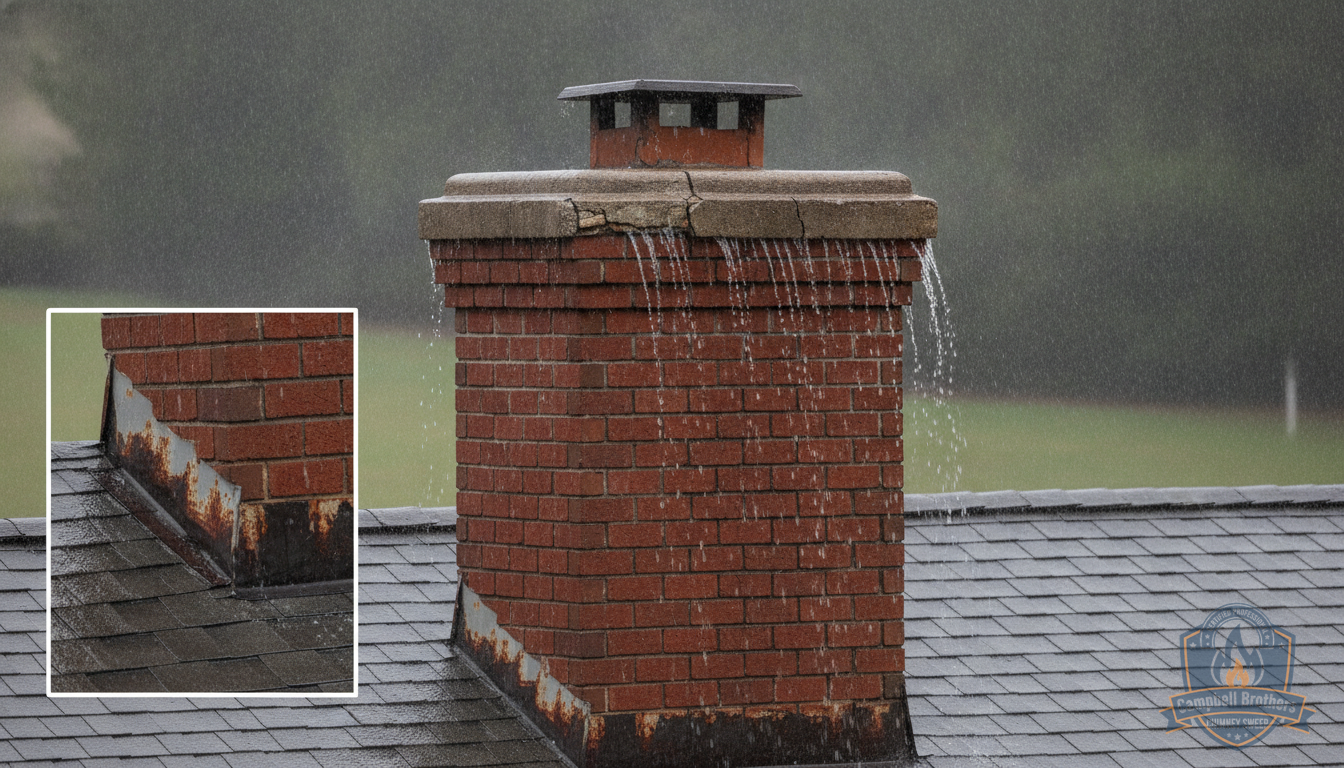
Why Water Is a Chimney's Biggest Threat
Most Charlotte homeowners worry about chimney fires — and rightly so — but water infiltration causes more cumulative damage to chimneys than fire in the vast majority of cases. Unlike a chimney fire, which is a dramatic and obvious event, water damage works slowly and silently. By the time you notice a water stain on your ceiling near the fireplace or peeling paint on the wall adjacent to the chimney, the damage is already well underway inside your masonry and attic framing.
Understanding where water enters and how to stop it is the most cost-effective chimney knowledge any Charlotte homeowner can have.
The Four Ways Water Gets Into Your Chimney
1. A Missing or Damaged Chimney Cap
Your chimney cap sits at the very top of the flue and is the first and simplest line of defense against rain. Without one, every rainstorm sends water directly down the flue opening and into the liner, smoke chamber, and firebox below. Charlotte averages over 40 inches of rain annually, so an uncapped chimney absorbs a significant amount of water every year.
A damaged cap — one with cracked mesh, rust holes, or a loose fit — is nearly as bad as no cap at all. Campbell Brothers Chimney Sweep installs heavy-gauge stainless steel chimney caps sized precisely to your flue opening. A properly fitted cap also keeps squirrels, raccoons, and nesting birds out of the flue — another common and preventable source of damage in Charlotte's wooded residential neighborhoods.
2. A Cracked or Deteriorated Chimney Crown
The chimney crown is the concrete slab that seals the top of the chimney's masonry around the flue tile. It's designed to slope outward and shed water away from the chimney body. Because it sits fully exposed to the elements year-round, the crown is typically the first masonry component to develop cracks.
Charlotte's seasonal freeze-thaw cycles — even our mild ones — cause water that has seeped into hairline cracks to expand and widen those cracks progressively each winter. What starts as a narrow surface crack can become a structural split within a few seasons. Campbell Brothers provides chimney crown repair and rebuild services ranging from elastomeric sealant applications on minor cracks to full crown reconstruction with proper slope and drip edge for more advanced deterioration.
3. Failing Chimney Flashing
Chimney flashing is the sheet metal and sealant system that bridges the gap where your chimney meets your roof. It's made up of step flashing woven between individual shingle courses and counter flashing embedded into the chimney's mortar joints. Over time, the caulk that seals counter flashing to the mortar dries and separates, and the metal itself can corrode or be lifted by wind-driven rain.
A leaking flashing joint channels water directly into the attic and wall framing — often without any water ever appearing inside the firebox itself, which makes it a notoriously difficult source to diagnose without a professional rooftop inspection. Our chimney flashing repair service covers both minor sealant repointing and full step-and-counter flashing replacement when the metal has reached the end of its service life.
4. Porous or Spalling Brick
Brick is not waterproof. The face of each brick and the mortar joints between them absorb moisture, and over decades of exposure that moisture weakens the masonry from the inside out. Spalling — where brick faces pop or flake away — is a clear sign that absorbed water is expanding inside the material during cold nights. Once spalling begins, water infiltration accelerates rapidly.
Addressing spalling brick and eroded mortar joints through tuckpointing and masonry repair is an important part of comprehensive chimney waterproofing, and it's work our team encounters regularly in established Charlotte neighborhoods.
How a Comprehensive Chimney Inspection Catches Water Entry Points
Because water can enter a chimney through multiple points simultaneously, the most efficient approach is a thorough chimney inspection that evaluates the cap, crown, flashing, exterior masonry, and flue liner in a single visit. Our Level II inspections include video camera scanning of the flue interior to identify liner cracks that allow water — and combustion gases — to escape into your home's structure.
We serve homeowners throughout Mecklenburg County, including SouthPark, Matthews, Pineville, Steele Creek, and University City. For a complete moisture protection evaluation of your chimney system, call Campbell Brothers Chimney Sweep at (980) 780-2225, Monday through Sunday, 8 AM to 6 PM.
The Cost of Waiting
A chimney cap installation or crown sealant repair costs a fraction of what liner replacement, attic remediation, or interior ceiling repair costs after prolonged water infiltration. The best time to address water entry points is before the damage compounds. If you haven't had your chimney inspected in the last year — or if you've noticed any of the warning signs below — contact us today:
- Water stains or efflorescence on exterior chimney brick
- Ceiling or attic staining near the chimney
- White mineral deposits (efflorescence) on the firebox interior
- Rust on the damper or firebox components
- Peeling paint or wallpaper on walls adjacent to the chimney
- A musty odor from the fireplace, especially after rain
Don't let a small crack become a large repair bill. Reach out to Campbell Brothers Chimney Sweep at (980) 780-2225 or email [email protected] to schedule your inspection.
Need Service?
Call +19807802225 or fill out our online form for a free, no-obligation quote.
Request Free Quote